

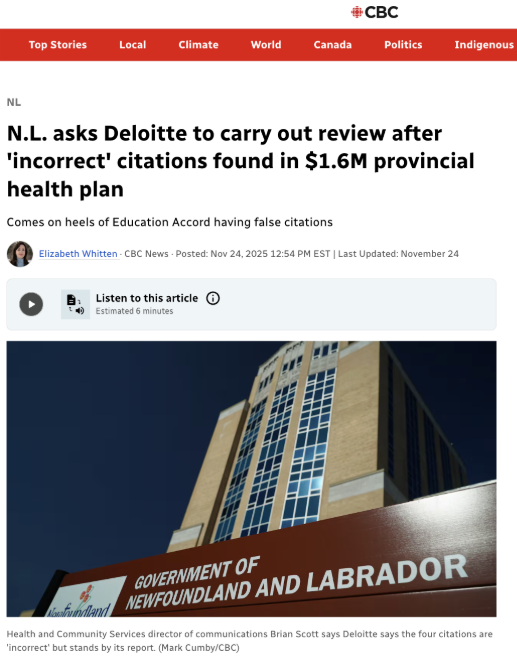
Late last year, a $1.6 million report in Canada was found to include fabricated citations — the second such incident involving a major consulting firm in recent months.
This wasn’t a minor oversight. It exposed a growing problem: organizations are deploying AI systems faster than they’re putting human oversight in place. Framing this as a single company’s quality control failure misses the point. The real risk is systemic — and as we move into 2026, that risk is becoming impossible to ignore.
And the cost of getting this wrong is climbing fast. Beyond the immediate financial hits, these incidents are eroding client trust, damaging professional reputations, and creating liability exposure that most organizations haven't even begun to calculate.
Why smarter AI demands smarter humans, not fewer
Here's the fundamental paradox of our AI-driven world: as these systems become more intelligent and automated, the role of humans becomes more important, not less. As AI gets more sophisticated, it can produce content that sounds authoritative, cite sources that seem credible, and make recommendations that appear well-reasoned — all while being completely wrong. This makes human judgment not optional, but essential.
Whether something was written by AI or finalized by AI, humans must be accountable. It's tempting to cut and paste because the content appears sophisticated and well-reasoned, but these high-profile incidents show exactly why humans must remain integral to the process — not just as final reviewers, but as active participants in decision-making and validation at every critical stage.
The pattern we're seeing isn't just about technical failures. It's about abdication of human responsibility. Companies are treating AI as a magic box that produces finished work rather than a powerful tool that amplifies human capability. They're confusing automation with autonomy, efficiency with accuracy.
When AI gets smarter, the stakes get higher. More sophisticated outputs mean more convincing errors. More automated processes mean fewer human touchpoints. More seamless integration means less obvious intervention points. This isn't a recipe for removing humans — it's an argument for making human oversight more strategic, more skilled, and more embedded in the workflow.
Humans bring something AI fundamentally cannot: accountability. When an AI system generates a report with fabricated citations, the AI doesn't face consequences. It doesn't understand the impact on client relationships or professional reputation. It can't take responsibility for the error or learn from the organizational damage caused.
But human oversight in the AI era isn't about slowing things down or adding bureaucratic layers. It's about being the intelligence that guides the intelligence. Humans can assess credibility in ways that pattern matching cannot. They can recognize when something "feels off" based on experience and intuition. They can weigh ethical implications and consider broader consequences that AI systems aren't designed to evaluate.
Most importantly, humans can make the judgment calls that separate good AI implementations from disasters. They can decide when to trust AI output, when to dig deeper, and when to override entirely. As AI becomes more capable of producing convincing but incorrect content, this human discernment becomes not just valuable — it becomes the primary differentiator between reliable and unreliable AI-powered organizations.
The competitive advantage of responsible AI leadership
While organizations race to deploy AI faster and cheaper, there's a massive opportunity for those willing to do it right. Clients aren't just becoming aware of AI risks — they're becoming sophisticated about them. They're starting to ask harder questions about verification processes, human oversight protocols, and accountability structures.
The firms that can demonstrate thoughtful human-AI partnerships aren't just avoiding catastrophic failures — they're building sustainable competitive advantages. They're the ones clients will trust with their most sensitive work. They're attracting top talent who want to work with cutting-edge technology responsibly. They're setting themselves up to lead in a world where AI literacy becomes a core business competency.
As AI becomes ubiquitous, what will differentiate one firm from another won't be access to AI tools, it will be the quality of human judgment applied to those tools. The ability to consistently produce accurate, reliable, and accountable AI-assisted work will be worth far more than the ability to produce fast, cheap, but unreliable outputs.
How we're approaching human-AI partnership at Agentiiv
At Agentiiv, we’re working to take steps to minimize hallucinations through expertly crafted agentic search Software Development Kits (SDK) that will utilize citations and through explicit prompt instructions. We’re also developing a specialized link verification tool. Before an agent generates a report based on research it conducted, it will use our link verification tool to doublecheck citation links and associated content from agent responses. Our verification engine will analyze these citations to confirm valid links (no 404s), produce confidence scores (high, medium, low) that the derived conclusion aligns with the content from the link page, generates validity determinations, and redirects the agent when needed to prevent hallucinated or broken citations. This automated verification process will validate link existence, credibility, and content relevance for every citation, providing research agents with quantified confidence metrics that catch errors before they reach users.
What this means for professional services
The organizations getting AI right are creating a new standard for professional services. Clients will start expecting not just AI capabilities but demonstrated human oversight and accountability structures. "AI-powered" is becoming table stakes — "AI-verified" and "human-accountable" will become the differentiators.
We're already seeing this shift in client conversations. Progressive clients are asking detailed questions about our verification processes, our human oversight protocols, and our error prevention systems. They want to understand not just what our AI can do, but how we ensure it does it reliably and accountably.
The regulatory environment is also evolving to require more human oversight, not less. Organizations that build robust human accountability into their AI processes now will be ahead of the curve when compliance requirements inevitably tighten.
Practical steps for human-accountable AI
For organizations looking to implement AI responsibly, here are the essential elements.
Establish clear accountability structures. Every AI-generated output needs a human who takes responsibility for its accuracy and appropriateness. This person should have the authority and expertise to validate, modify, or reject AI recommendations.
Build judgment checkpoints into workflows. Don't treat human oversight as an add-on — make it integral to how AI outputs are generated. Create specific points where humans assess not just accuracy but contextual appropriateness and strategic alignment.
Develop AI literacy across teams. Everyone working with AI should understand not just how to use it, but how it fails, what to watch for, and when human intervention is necessary. This includes understanding the difference between AI confidence and actual accuracy.
Create escalation protocols. Define clear processes for when AI outputs need additional human review, validation, or expert consultation. Make it easy for team members to flag uncertain or problematic content.
Plan for sophisticated failures. As AI becomes more advanced, its mistakes become more subtle and convincing. Build systems specifically designed to catch the kind of sophisticated errors that only human judgment can identify.
The path forward: Human intelligence enhanced, not replaced
The future belongs to organizations that understand a fundamental truth: as AI becomes more powerful, human judgment becomes more valuable, not less. The goal was never to eliminate human expertise — it was to amplify it through intelligent partnerships with AI systems.
Every fake citation, every hallucinated recommendation, every AI-generated error that slips through represents not just a technical failure but a failure of human accountability. The question isn't whether AI will make mistakes — it's whether we'll build organizations that consistently catch those mistakes through skilled human oversight.
The firms that master this balance first won't just avoid AI disasters — they'll build sustainable competitive advantages in an AI-powered world. They'll be the ones clients trust with their most critical work, regulators respect for their responsible practices, and top talent wants to join.
The technology is powerful enough to transform how we work, but only if we're smart enough to keep humans in control of that transformation. Not as bottlenecks or afterthoughts, but as the intelligent partners that make AI systems truly reliable, accountable, and valuable.

Become a Leaderin your Industry.
Scale your operations with enterprise-grade AI solutions today.